CNC Machining Manufacturing: An Overview of Modern Production Processes
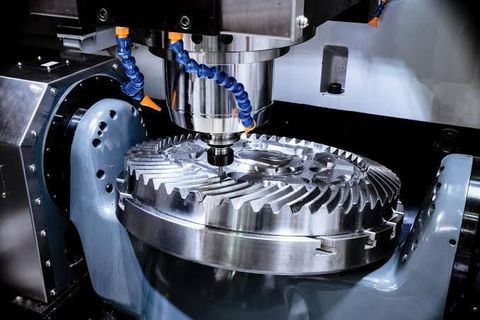
CNC machining manufacturing is a production method in which computer-controlled machines remove material from a workpiece to create a specified shape.
CNC stands for computer numerical control, meaning that machining movements are controlled through programmed instructions. The technology developed from earlier numerical-control machines and became increasingly connected with computer-aided design and manufacturing software.
CNC machining equipment can work with materials such as metals, plastics, composites, and other engineering materials. Depending on the machine configuration, cutting tools can drill, mill, turn, bore, thread, or perform other operations. These processes are used to create components with defined dimensions and surface characteristics.
How CNC Machining Works
A typical CNC production process begins with a digital part design. The design is converted into machining instructions, commonly called G-code or numerical-control code, which tells the machine how the cutting tool should move.
The general process can include these stages:
- Part design: A digital model defines the required geometry and dimensions.
- Process planning: Machining operations, tools, workholding, and cutting conditions are selected.
- Programming: Software generates or prepares machine instructions.
- Setup: The workpiece, tools, and machine coordinates are prepared.
- Machining: The CNC machine follows programmed movements to remove material.
- Inspection: Measurements are taken to verify dimensions and other requirements.
This sequence can vary depending on the component, material, machine type, and production environment.
Types of CNC Machining Machines
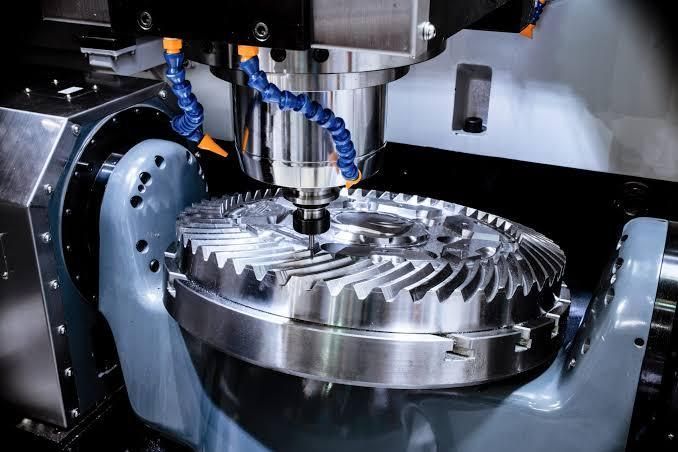
CNC machining machinery includes several machine categories. CNC milling machines use rotating cutting tools to remove material from stationary or repositioned workpieces. CNC turning machines generally rotate the workpiece while a cutting tool moves against it.
CNC machining centers can combine several operations within one machine. Horizontal and vertical configurations are common, while multi-axis machines can coordinate movement along several axes to produce more complex geometries.
| CNC Machine Type | Typical Function | Common Applications |
|---|---|---|
| CNC milling machine | Cutting and shaping with rotating tools | Housings, brackets, plates |
| CNC turning machine | Cutting rotating workpieces | Shafts, pins, cylindrical components |
| CNC machining center | Multiple cutting operations | Complex mechanical parts |
| Multi-axis CNC machine | Coordinated movement across several axes | Complex contours and components |
| CNC drilling machine | Hole creation and related operations | Plates, frames, mechanical parts |
Importance
CNC machining is important because many products require components with controlled dimensions and repeatable geometries. Industrial CNC machining is used across sectors such as transportation, electronics, medical equipment, energy, machinery, and general manufacturing.
For everyday products, CNC-manufactured components may be present inside machines, vehicles, appliances, electronic equipment, and infrastructure. The machining process therefore has an indirect connection to many products and systems used in daily life.
Supporting Precision Manufacturing
Precision CNC machining allows programmed tool movements to be coordinated with specific dimensions. Measurement equipment can then be used to check whether the finished component matches the required specifications.
High precision CNC machining systems are particularly relevant when components have tight dimensional requirements or complex shapes. Actual results depend on machine condition, tooling, material properties, programming, workholding, measurement methods, and environmental conditions.
Improving Production Repeatability
CNC manufacturing equipment can repeat programmed movements across multiple production cycles. This can make it easier to reproduce a defined geometry than relying entirely on manual machine movements.
Automated CNC machining systems can also connect machining with automatic tool changes, material handling, probing, inspection, or other equipment. The level of automation varies considerably between production environments.
Addressing Complex Components
Some components contain curved surfaces, multiple holes, pockets, threads, or other detailed features. Advanced CNC machining equipment can coordinate several machine axes and cutting operations to create these geometries.
Industrial precision machining systems can also combine machining, measurement, and digital process information. However, greater complexity can introduce additional programming, setup, inspection, and maintenance requirements.
Recent Updates
Between 2024 and 2026, CNC manufacturing has continued moving toward greater digital integration, automation, simulation, and data connectivity. Industry events and technology developments have increasingly highlighted smart manufacturing, digital twins, automated processes, and connected machine tools.
Digital Twins and Virtual Validation
Digital twin technology has become an important development in CNC production. A CNC digital twin can represent machine behavior, control logic, tool movement, and other characteristics in a virtual environment.
Manufacturers can use simulations to examine tool paths and machining processes before running them on physical equipment. Siemens describes digital-twin applications that allow CNC programs and machining processes to be tested virtually, including collision and setup checks.
This approach is particularly relevant to high precision CNC machining systems because virtual validation can provide another stage for identifying programming or process issues before physical machining begins.
AI and CAM Software
AI-related capabilities are also being incorporated into computer-aided manufacturing software. Recent developments have included automated feature recognition and other functions intended to assist programming and machining preparation.
AI does not replace the physical requirements of CNC machining. Machine operators, programmers, engineers, and inspectors still need to account for material behavior, tooling, machine limitations, tolerances, safety requirements, and measurement results.
Greater Automation and Connectivity
Modern automated CNC production equipment can connect machines with software, sensors, material-handling systems, and inspection equipment. This can create a more continuous flow of information between design, programming, production, and quality-control activities.
Industrial CNC manufacturing systems are also increasingly designed around data collection and digital monitoring. The exact capabilities vary according to machine architecture and the surrounding manufacturing system.
Tools and Resources
Several categories of tools support CNC machining manufacturing, from initial design through inspection.
CAD and CAM Software
CAD software is used to create digital component designs, while CAM software helps convert those designs into machining strategies and machine instructions. CAM platforms can include toolpath generation, machining simulation, and post-processing functions.
Simulation tools can help review tool movements before production. Digital-twin platforms can extend this concept by representing aspects of the actual machine and machining environment.
CNC Programming Resources
CNC programming references explain commands, coordinate systems, tool offsets, feeds, speeds, and machine-specific functions. Manufacturer documentation is particularly important because CNC controls can differ between machine models and control systems.
Educational resources may also include:
- CNC programming manuals for understanding machine instructions.
- CAD/CAM tutorials for learning digital machining workflows.
- Tool-selection charts for comparing cutting-tool characteristics.
- Machining calculators for estimating cutting parameters.
- GD&T references for understanding dimensional and geometric requirements.
- Inspection guides for learning measurement principles.
Measurement and Inspection Tools
Inspection is an important part of CNC production. Common equipment includes calipers, micrometers, height gauges, coordinate measuring machines, and optical measurement systems.
Inspection results can be used to determine whether a machined component meets its specified dimensions. Automated inspection systems may also communicate measurement data with production software in more connected manufacturing environments.
Advanced Manufacturing Systems
Advanced CNC manufacturing machinery can combine machining, automated workholding, tool management, probing, inspection, and production monitoring. These systems are often designed around a defined production workflow rather than a single machine operation.
Complete CNC machining systems may therefore include several connected components. The appropriate arrangement depends on production volume, part geometry, material, tolerance requirements, available floor space, and process complexity.
FAQs
What is CNC machining manufacturing?
CNC machining manufacturing is a subtractive production method that uses computer-controlled machine tools to remove material from a workpiece. The machine follows programmed instructions to create a defined shape.
What are CNC machining machines used for?
CNC machining machines are used to create components with controlled dimensions and geometries. Common operations include milling, turning, drilling, boring, threading, and contouring.
What is industrial CNC machining?
Industrial CNC machining refers to the use of CNC equipment and related systems in manufacturing environments. It can include CNC milling machines, CNC turning machines, machining centers, automated material handling, inspection equipment, and production software.
What are high precision CNC machining systems?
High precision CNC machining systems are designed for applications where dimensional accuracy and controlled machining processes are important. Their results depend on machine capability, programming, tooling, workholding, inspection, and environmental conditions.
How is CNC manufacturing equipment becoming more automated?
CNC manufacturing equipment can be connected with automatic tool changers, probing systems, robotic material handling, inspection equipment, production software, and digital simulation tools. The level of automation differs according to the manufacturing process.
Conclusion
CNC machining manufacturing combines computer-controlled equipment, digital designs, machining tools, programming, and inspection processes to produce defined components. CNC milling machines, CNC turning machines, machining centers, and multi-axis systems support different production requirements. Recent developments have focused on digital twins, AI-assisted programming, automation, simulation, and greater connectivity between production systems. These developments are expanding how CNC machining machinery is planned, monitored, and integrated into modern manufacturing environments.