Industrial Ventilation Systems Guide to Airflow, Filtration, and Air Exchange
Industrial ventilation systems are designed to move and manage air within factories, warehouses, workshops, processing facilities, and other large buildings.
They help introduce outdoor air, remove unwanted air, control airborne contaminants, and maintain suitable indoor conditions. An industrial ventilation system can combine fans, ducts, filters, dampers, sensors, and control equipment.
The concept of ventilation comes from the basic need to replace stale or contaminated air with cleaner air. Early industrial facilities often relied on doors, windows, roof openings, and natural airflow. As buildings became larger and industrial processes more complex, mechanical equipment became necessary to control airflow more consistently.
Modern industrial air ventilation systems can use mechanical fans and duct networks to direct air between specific locations. Depending on the application, ventilation may focus on general air exchange or local removal of dust, fumes, heat, moisture, or other airborne materials.
Main Components of an Industrial Ventilation System
Industrial ventilation equipment varies according to building size and process requirements. Common components include:
- Industrial exhaust fans for removing air from designated areas.
- Supply fans for bringing outdoor or conditioned air into a building.
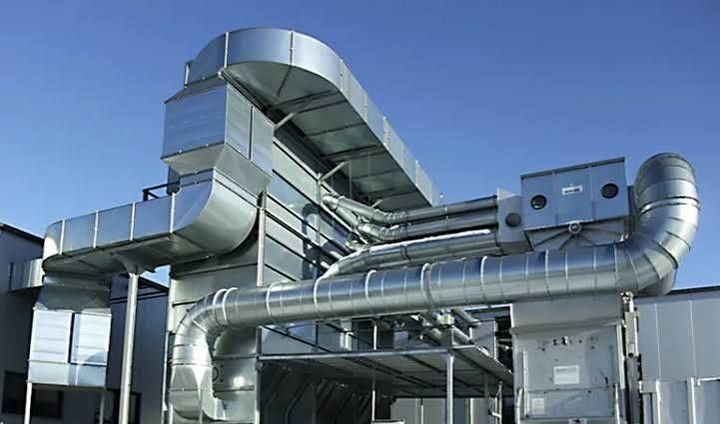
- Ductwork for transporting air between locations.
- Filters for capturing selected airborne particles.
- Dampers for controlling airflow through ducts.
- Grilles and diffusers for distributing incoming air.
- Sensors for monitoring temperature, pressure, humidity, or air quality.
- Control systems for adjusting equipment operation.
The arrangement of these components determines how effectively air moves through a facility. Poorly positioned openings or incorrectly sized ductwork can affect airflow patterns and create areas with limited air movement.
Airflow, Filtration, and Air Exchange
Airflow describes the movement of air through a building or ventilation network. Air exchange refers to replacing indoor air with outdoor air or moving air through a treatment process.
Filtration is different from air exchange. An industrial air filtration system removes specific particles or contaminants from an air stream, while ventilation primarily manages the movement and replacement of air. Some facilities use both approaches together.
Importance
Ventilation affects workers, equipment, products, and building conditions. Industrial facilities may generate heat, dust, fumes, vapors, moisture, or other airborne contaminants during normal operations. Without suitable airflow management, these materials can accumulate in particular areas.
Factory ventilation systems help manage air movement across larger spaces. Localized systems can focus on specific sources, such as a machine that produces dust or a process that generates fumes.
Managing Airborne Contaminants
Industrial dust extraction systems are designed to capture and transport dust-laden air away from selected processes. Their configuration depends on the type of dust, its source, particle characteristics, and the surrounding process.
Industrial fume extraction systems work on a similar principle but are intended for fumes, vapors, or gases generated by particular activities. Local capture can reduce the amount of unwanted material entering the general workplace air.
Industrial air purification systems may use filtration or other treatment methods to address particular airborne contaminants. The appropriate technology depends on what needs to be removed and the characteristics of the air stream.
Supporting Indoor Conditions
Ventilation also influences temperature and humidity. Industrial HVAC ventilation systems can combine ventilation with heating or cooling equipment to manage indoor conditions.
Industrial air handling systems may condition, filter, mix, and distribute air before it reaches occupied or process areas. Their design can vary considerably between a warehouse, manufacturing facility, laboratory, food-processing area, and other industrial environments.
Understanding Different Ventilation Approaches
Different facilities require different airflow arrangements. The following table provides a simplified comparison.
| Ventilation approach | Main purpose | Typical application |
|---|---|---|
| General ventilation | Dilute and replace indoor air | Warehouses and production areas |
| Local exhaust | Capture contaminants near their source | Welding or process equipment |
| Dust extraction | Collect airborne particles | Cutting and material processing |
| Fume extraction | Remove fumes or vapors | Welding and chemical processes |
| Air filtration | Remove selected particles | Recirculated or conditioned air |
| HVAC ventilation | Combine air exchange with conditioning | Occupied industrial buildings |
The actual design should account for the building, process, airflow requirements, contaminants, equipment arrangement, and applicable safety requirements.
Recent Updates
Between 2024 and 2026, industrial ventilation has increasingly incorporated sensors, automated controls, connected equipment, and data monitoring. The broader direction is toward systems that can respond to changing conditions rather than operating at one fixed setting throughout the day.
Advanced industrial ventilation systems may use sensors to monitor temperature, pressure, humidity, particulate levels, or other selected conditions. Automated controls can then adjust fans, dampers, or other components according to programmed parameters.
Automated Airflow Management
Automated industrial ventilation systems can use variable-speed drives and control logic to adjust fan operation. For example, airflow may change according to occupancy, equipment activity, measured conditions, or a predefined operating schedule.
This approach can also provide operational data for maintenance and system analysis. However, automation introduces additional controls and electronic components that need appropriate configuration and monitoring.
Energy and Air Quality Considerations
High efficiency industrial ventilation is increasingly associated with controlling airflow according to actual requirements. Moving air requires energy, particularly when large fans operate continuously. Variable airflow can therefore be part of a broader approach to managing building energy use.
Industrial air quality control systems may combine sensors, filtration, ventilation, and monitoring software. The information collected can help identify changes in indoor conditions and support operational decisions.
Greater System Integration
Modern industrial ventilation equipment can increasingly communicate with building management systems and other industrial controls. This can allow ventilation information to be viewed alongside temperature, energy, equipment, and environmental data.
Commercial industrial ventilation applications may also use integrated controls where buildings contain offices, storage areas, production spaces, and other zones with different ventilation requirements.
Tools and Resources
Several tools and reference materials can help explain or assess ventilation requirements. Their usefulness depends on the type of facility and the purpose of the assessment.
Airflow Calculation Resources
Basic airflow calculations commonly consider room volume, required air movement, duct dimensions, fan capacity, and pressure differences. Airflow calculators and duct-sizing tools can help users understand these relationships.
Useful resources include:
- Airflow and duct-sizing calculators.
- Ventilation planning worksheets.
- Fan performance charts.
- Filter selection references.
- Indoor air quality measurement tools.
- Building and industrial ventilation guidelines.
These resources provide general information, while detailed industrial designs may require site-specific engineering analysis.
Standards and Technical References
Organizations such as ASHRAE, OSHA, and NIOSH publish technical information related to ventilation, indoor air quality, workplace exposure, and engineering practices. Manufacturer documentation can also explain the operating characteristics of specific fans, filters, sensors, and control components.
Industrial ventilation equipment suppliers may publish product documentation containing airflow ranges, pressure information, filter specifications, dimensional data, and installation requirements. Such information can help readers understand how individual components fit into a ventilation system.
System Monitoring Tools
Digital monitoring platforms can display sensor readings and equipment status. Depending on the system, users may monitor airflow, pressure, temperature, humidity, filter condition, or fan operation.
Maintenance records and inspection templates can also help track recurring checks. Keeping clear records can make it easier to identify changes in system performance over time.
FAQs
What are industrial ventilation systems used for?
Industrial ventilation systems manage airflow in factories, workshops, warehouses, and other large facilities. They can introduce outdoor air, remove contaminated air, control heat and moisture, and support indoor environmental conditions.
How do industrial exhaust systems work?
Industrial exhaust systems use fans, ducts, hoods, and related components to capture or move unwanted air away from a particular location. Industrial exhaust fans create the airflow needed to transport air through the system.
What is the difference between industrial air filtration systems and ventilation?
Industrial air filtration systems are primarily intended to remove specified contaminants from an air stream. Ventilation focuses on moving and replacing air, although a ventilation system can include filters as part of its design.
What are industrial dust extraction systems used for?
Industrial dust extraction systems capture airborne particles generated by processes such as cutting, grinding, sanding, or material handling. They typically use collection points, ductwork, filtration equipment, and an air-moving device.
How do automated industrial ventilation systems operate?
Automated industrial ventilation systems use controls and sensors to adjust ventilation equipment according to programmed conditions. Depending on the design, fan speed or airflow may change in response to temperature, pressure, occupancy, air quality measurements, or process activity.
Conclusion
Industrial ventilation systems manage airflow, air exchange, filtration, and contaminant removal across many types of facilities. Industrial exhaust systems, filtration equipment, air handling systems, and automated controls can perform different roles within a broader ventilation arrangement. Recent developments have placed greater emphasis on sensors, system integration, variable airflow, and digital monitoring. The appropriate configuration depends on the building, processes, contaminants, environmental conditions, and applicable technical requirements.