How Knitting Machine Manufacturing Works: A Complete Guide
Knitting machine manufacturing involves the design, fabrication, assembly, calibration, and testing of equipment used to convert yarn into knitted fabric.
Unlike weaving, which interlaces separate warp and weft yarns, knitting forms fabric through interconnected loops.
Industrial knitting machines contain precision mechanical components, needles, yarn-feeding systems, drive mechanisms, control electronics, and fabric take-up arrangements. Their configuration varies according to the type of fabric, yarn, production method, and level of automation required.
Why Knitting Machine Manufacturing Matters
The performance of a knitting machine depends on how accurately its mechanical and electronic components work together. Small variations in needle movement, yarn feeding, timing, or fabric take-up can influence fabric structure and production consistency.
Manufacturing therefore involves more than assembling individual components. It includes material selection, precision machining, component inspection, assembly, software or control integration, calibration, and operational testing.
Different machines are designed for applications ranging from apparel and hosiery to technical textiles and industrial fabrics.
How Knitting Machine Manufacturing Works
A typical manufacturing process includes several stages:
- Machine design: Engineers define the machine architecture, dimensions, knitting mechanism, controls, and intended fabric applications.
- Material selection: Metals, polymers, electronic components, and other materials are selected for individual parts.
- Component manufacturing: Frames, cylinders, cams, needle beds, feeders, shafts, and other components are fabricated or machined.
- Surface treatment: Selected parts may undergo finishing, coating, heat treatment, or other processes to achieve required properties.
- Component inspection: Dimensions and tolerances are checked before assembly.
- Mechanical assembly: Major components are installed and aligned.
- Electronic integration: Sensors, motors, controllers, displays, and automation components are connected.
- Calibration: Machine timing, yarn feeding, needle movement, and other operating parameters are adjusted.
- Testing: The completed machine is operated under controlled conditions to identify mechanical, electrical, or fabric-related issues.
This sequence can vary according to machine design and manufacturing practices.
Main Types of Knitting Machines
Circular Knitting Machines
Circular knitting machines use needles arranged around a cylinder to produce tubular knitted fabric.
They are widely used for fabrics such as jersey, rib, interlock, and other circular-knit structures. Machine diameter, needle configuration, number of feeders, and gauge influence the resulting fabric.
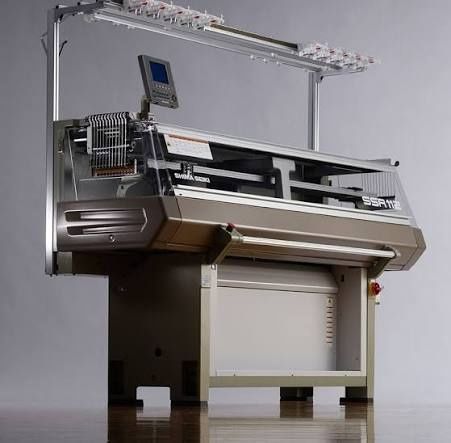
Flat Knitting Machines
Flat knitting machines use needles arranged along a flat needle bed.
They can produce shaped panels and complex knitted structures. Modern flat knitting machines may incorporate electronic controls that manage needle selection and pattern formation.
Warp Knitting Machines
Warp knitting machines form loops using multiple yarns supplied in the warp direction.
They are used for fabrics requiring particular dimensional characteristics and can produce structures used in apparel, technical textiles, and other applications.
Hosiery Knitting Machines
Specialized hosiery machines are designed to produce socks, stockings, and similar knitted products.
Their construction typically focuses on precise needle control, yarn feeding, and shaping.
Key Components in Knitting Machine Manufacturing
Needles
Needles are among the most important working components in a knitting machine.
Their movement creates loops and directly influences the knitted structure. Needle dimensions and configuration vary according to machine type and fabric requirements.
Needle Bed or Cylinder
Flat knitting machines generally use needle beds, while circular machines use cylinders and associated components.
These structures position and guide the needles during knitting.
Cam System
Cams control needle movement in many knitting machines.
Their shape and arrangement determine how needles rise, fall, and interact with yarn during each knitting cycle.
Yarn Feeders
Yarn feeders deliver yarn to the knitting zone at controlled positions and rates.
Consistent yarn delivery is important for maintaining loop formation and fabric uniformity.
Drive System
Motors, shafts, gears, belts, and other drive components coordinate machine movements.
Modern machines may use electronically controlled drives to provide precise speed and timing control.
Control System
Electronic controllers manage machine functions such as speed, needle selection, pattern settings, yarn monitoring, and machine status.
Computerized controls can provide operators with access to detailed machine parameters.
Important Knitting Machine Specifications
| Specification | Importance |
|---|---|
| Machine gauge | Indicates needle density and influences fabric structure |
| Knitting width | Defines the working width of flat or applicable machines |
| Cylinder diameter | Determines tubular fabric dimensions in circular machines |
| Number of feeders | Influences yarn supply and production configuration |
| Machine speed | Affects knitting cycle frequency |
| Needle count | Determines available needle positions |
| Yarn range | Indicates compatible yarn characteristics |
| Pattern capability | Determines available fabric designs |
| Control system | Manages machine operation and settings |
| Power requirement | Supports facility planning |
Specifications should be evaluated together because machine speed, gauge, yarn type, and fabric construction are closely related.
Factors Affecting Knitting Machine Manufacturing
Precision and Tolerances
Knitting machines contain many closely interacting components.
Accurate dimensions and appropriate tolerances are important because small variations can affect needle movement, yarn handling, timing, and machine operation.
Material Selection
Components exposed to repeated movement or friction require materials appropriate for their operating conditions.
The selection of metals, alloys, polymers, coatings, and other materials depends on component function and expected operating loads.
Component Surface Finish
Smooth and controlled surfaces can be important for components that interact with yarn or moving parts.
Surface characteristics can influence friction, wear, yarn handling, and component life.
Electronic Integration
Modern knitting machines increasingly combine mechanical mechanisms with electronic controls and sensors.
Successful integration requires coordination between motors, controllers, sensors, pattern systems, and mechanical movements.
Quality Testing
Manufactured machines can undergo dimensional inspection, mechanical testing, electrical testing, and fabric-production trials.
Testing helps identify alignment, timing, yarn-feeding, control, and other operational issues before the machine enters regular production.
Knitting Machine Manufacturing vs. Weaving Machine Manufacturing
Both machine categories are used for textile production, but their operating mechanisms differ.
| Feature | Knitting Machines | Weaving Machines |
|---|---|---|
| Fabric formation | Interconnected yarn loops | Interlaced warp and weft |
| Main working element | Needles | Loom mechanisms and reed |
| Common machine types | Circular, flat, warp | Rapier, air-jet, water-jet, projectile |
| Fabric characteristics | Often flexible and stretchable | Often structured and dimensionally stable |
| Pattern formation | Needle and yarn control | Shedding and weft insertion |
| Typical products | Knitwear, hosiery, technical fabrics | Apparel, home textiles, industrial fabrics |
The appropriate machine depends on the required fabric structure, elasticity, appearance, production method, and yarn characteristics.
Applications of Industrial Knitting Machines
Apparel Production
Knitting machines produce fabrics used for shirts, sweaters, sportswear, underwear, dresses, and other garments.
Hosiery
Specialized machines produce socks, stockings, and related products using controlled loop formation.
Home Textiles
Knitted fabrics can be used in blankets, furnishings, covers, and other household textile products.
Technical Textiles
Specialized knitting technologies can produce fabrics for filtration, medical applications, automotive components, construction, and other technical uses.
Seamless Garments
Computerized knitting equipment can produce selected garments or garment sections with reduced cutting and sewing requirements.
Best Practices for Knitting Machine Manufacturing
- Define the intended fabric: Identify structure, gauge, width, weight, and pattern requirements.
- Select appropriate materials: Match component materials to mechanical loads and operating conditions.
- Maintain dimensional accuracy: Control component tolerances during machining and assembly.
- Inspect critical components: Check needles, cams, feeders, cylinders, beds, shafts, and drive components.
- Align mechanical assemblies: Proper alignment supports coordinated machine movement.
- Integrate controls carefully: Ensure sensors, motors, controllers, and software communicate correctly.
- Calibrate operating parameters: Adjust timing, yarn feeding, speed, and needle movement.
- Perform fabric trials: Produce test fabric to evaluate machine operation.
- Monitor vibration and noise: Unexpected changes can indicate mechanical issues.
- Document machine settings: Maintain records for calibration, testing, and future adjustments.
Who Are Knitting Machines Suitable For?
Industrial knitting machines are relevant to textile manufacturers, apparel producers, hosiery operations, technical textile facilities, and fabric-processing businesses.
The appropriate machine depends on the desired fabric construction, yarn type, production volume, gauge, width, pattern requirements, and automation level.
Circular machines can suit continuous tubular fabric production, while flat machines provide greater flexibility for shaped panels and selected complex structures.
Frequently Asked Questions
What is knitting machine manufacturing?
Knitting machine manufacturing is the process of designing, producing, assembling, calibrating, and testing machines used to convert yarn into knitted fabric.
What are the main types of knitting machines?
The main categories include circular knitting machines, flat knitting machines, warp knitting machines, and specialized hosiery machines.
What components are used in knitting machines?
Important components include needles, needle beds or cylinders, cams, yarn feeders, drive mechanisms, motors, sensors, controllers, and fabric take-up systems.
What factors affect knitting machine performance?
Machine gauge, yarn characteristics, needle condition, yarn feeding, machine speed, timing, fabric structure, component precision, and maintenance can all influence performance.
What is the difference between circular and flat knitting machines?
Circular machines use needles arranged around a cylinder and commonly produce tubular fabric. Flat knitting machines use a flat needle bed and can produce shaped fabric panels and more complex structures.
Conclusion
Knitting machine manufacturing combines precision mechanical engineering, textile technology, electronics, automation, and quality testing. The manufacturing process typically moves from machine design and component production to assembly, control integration, calibration, and fabric-production testing.
Circular, flat, warp, and specialized knitting machines address different textile applications. Factors such as gauge, needle configuration, yarn compatibility, machine speed, pattern capability, component precision, and control technology are important when evaluating equipment.
Understanding how these machines are manufactured provides useful context for selecting equipment according to fabric requirements and production conditions.