Industrial Assembly Equipment: A Guide to Modern Assembly Systems
Industrial assembly equipment refers to machines, tools, robotic systems, and control technologies used to join, position, fasten, inspect, or handle components during manufacturing.
These systems range from manually assisted equipment to highly automated production lines. They are used across industries such as automotive, electronics, appliances, medical devices, packaging, and general manufacturing.
The development of industrial assembly systems began with mechanical production methods designed to make repeated assembly tasks more consistent. As electrical controls, computers, sensors, and robotics developed, manufacturers gained new ways to coordinate individual machines and production stages.
Today, automated assembly equipment can perform tasks such as component placement, fastening, pressing, welding, dispensing, testing, and inspection. A system may use conveyors, programmable controllers, sensors, cameras, robots, and specialized machinery to move products through defined assembly steps.
Main Types of Assembly Equipment
Industrial assembly machines vary according to the components being handled and the type of joining process required. Manufacturing assembly equipment can include presses, screw-driving systems, riveting machines, dispensing units, joining equipment, conveyors, inspection stations, and robotic arms.
Some common categories include:
- Industrial assembly machinery for repetitive joining and positioning tasks.
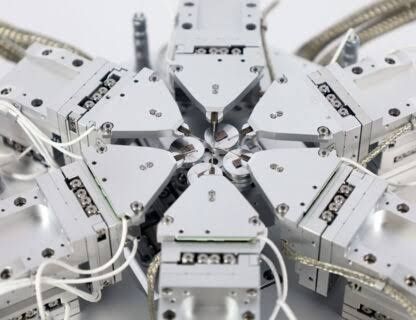
- Precision assembly equipment for components requiring controlled alignment.
- Robotic assembly systems for programmed handling and placement.
- Industrial assembly line equipment for moving products through sequential stages.
- Automated production assembly systems that coordinate several operations.
- Flexible assembly systems designed to accommodate changes in products or production requirements.
The equipment selected for a particular process depends on factors such as component dimensions, required tolerances, production volume, available space, and the complexity of the assembly.
How an Assembly System Works
A typical automated assembly system begins with component feeding or positioning. Sensors can identify the presence or location of parts, while mechanical devices or robots move them into the required position.
The system then performs one or more assembly operations. After joining or fastening, inspection equipment may check dimensions, position, appearance, or other predefined characteristics before the assembled product moves to another stage.
Importance
Industrial assembly equipment plays an important role in modern manufacturing because many products contain numerous components that must be assembled in a consistent sequence. Electronics, vehicles, appliances, machinery, and other products can require hundreds or thousands of individual assembly actions.
Automation can also address practical production challenges involving repetitive movements, precise positioning, process timing, and coordination between different manufacturing stages. The effects can extend beyond factories because assembly methods influence how products are produced and inspected before reaching consumers.
Improving Process Consistency
Repeated manual assembly can involve variation caused by differences in positioning, tool use, timing, or operator technique. Automated assembly systems can follow programmed sequences and predefined operating parameters.
This does not eliminate variation entirely. Equipment condition, component quality, calibration, software settings, and environmental factors can all influence the result.
Supporting Precision
Precision automated assembly systems are particularly relevant when components have narrow alignment requirements. Sensors, vision systems, controlled actuators, and robotic equipment can help position parts according to programmed parameters.
High precision assembly equipment may be used for small electronic components, mechanical assemblies, optical devices, and other products where alignment is important.
Coordinating Multiple Operations
An industrial assembly line can combine several stages within one connected workflow. For example, a product might move from component placement to fastening, inspection, testing, and packaging.
This arrangement can reduce unnecessary movement between separate work areas and provide a structured sequence for manufacturing activities. Industrial automation equipment can coordinate these stages through controllers, sensors, software, and communication networks.
Factors That Influence System Design
The design of an assembly system depends on the manufacturing process rather than a single universal configuration. Important considerations include:
- Product size and component geometry.
- Required assembly precision.
- Production volume and cycle requirements.
- Number and type of assembly operations.
- Available floor space.
- Material handling requirements.
- Inspection and testing needs.
- Worker interaction and safety considerations.
- Integration with existing manufacturing systems.
Recent Updates
From 2024 through 2026, industrial assembly has increasingly incorporated robotics, machine vision, connected controls, data collection, and flexible production methods. The general direction has been toward systems that can handle greater process variation while maintaining structured control over individual operations.
Advanced assembly automation systems increasingly combine mechanical equipment with software-based monitoring. This can provide information about equipment status, production stages, alarms, and process conditions.
Growth of Robotic Assembly Systems
Industrial robotic assembly equipment is being used for tasks such as component handling, positioning, fastening, dispensing, and inspection. Robots can be programmed for repeated movements and can be integrated with cameras, sensors, and specialized end-of-arm tools.
Collaborative robotic systems have also become part of some assembly environments. These systems are designed for particular forms of interaction between people and robots, with their suitability depending on the task, risk assessment, equipment configuration, and applicable safety requirements.
Flexible Assembly Systems
Flexible assembly systems are designed to accommodate changes in product configuration, component type, or production sequence. Software-controlled equipment and programmable robots can make certain changes through revised instructions rather than extensive mechanical reconstruction.
Flexibility is particularly relevant where manufacturers produce multiple product variants on related equipment. However, changing a process can require new tooling, programming, validation, and testing.
Vision and Data Integration
Machine vision is increasingly integrated into industrial assembly machinery for tasks such as component identification, orientation checks, presence detection, and dimensional inspection. Vision systems can provide information to controllers or robots so that subsequent actions follow the programmed workflow.
Data connectivity is another area of development. Automated manufacturing assembly systems may collect information about cycle times, equipment conditions, production counts, and inspection results. Such information can support process analysis and equipment monitoring.
| Assembly Approach | Typical Characteristics | Common Applications |
|---|---|---|
| Manual assembly | Human-controlled tools and components | Low-volume or variable assembly |
| Semi-automated assembly | People and machines share tasks | Repetitive operations with human input |
| Automated assembly | Machines perform defined sequences | Repetitive production processes |
| Robotic assembly | Programmable robots handle selected operations | Handling, fastening, placement |
| Flexible assembly | Equipment accommodates product variation | Multiple product configurations |
| Integrated assembly | Several machines and controls operate together | Connected production lines |
Tools and Resources
Several tools can help explain, design, operate, and evaluate industrial assembly systems. Their use depends on the production process and the level of automation involved.
Design and Planning Tools
Computer-aided design software can be used to create component and equipment layouts. Process-mapping and workflow tools can help document the sequence of assembly operations before physical equipment is configured.
Simulation software can also model robotic movements, material flows, and production sequences. These digital models can help identify possible interference, space limitations, or workflow issues during planning.
Industrial Control Resources
Programmable logic controllers, human-machine interfaces, industrial sensors, and robotic controllers are common components of automated assembly equipment. Technical manuals and manufacturer documentation explain configuration, operating parameters, communication methods, and maintenance requirements.
Standards organizations and industrial safety authorities also publish information relevant to machinery design, workplace safety, robotics, and automation. These resources can help readers understand the principles behind industrial automation equipment.
Measurement and Inspection Tools
Precision assembly equipment may be combined with measurement devices such as digital gauges, force sensors, vision cameras, and coordinate measurement equipment. The appropriate measurement method depends on the component and the characteristic being checked.
Process documentation templates can also record assembly steps, inspection criteria, equipment settings, and quality checks. Clear documentation helps establish a common reference for operators, engineers, and maintenance teams.
FAQs
What is industrial assembly equipment?
Industrial assembly equipment includes machines, tools, robots, controls, and related systems used to position, join, fasten, inspect, or handle components during manufacturing.
How do automated assembly systems work?
Automated assembly systems use programmed equipment, sensors, controllers, and mechanical or robotic components to perform defined assembly steps. Components move through a planned sequence, with inspection or testing included where required.
What is precision assembly equipment used for?
Precision assembly equipment is used when components need controlled positioning, alignment, force, or movement. It can be applied to electronics, mechanical products, optical components, and other assemblies with specific dimensional requirements.
What are robotic assembly systems?
Robotic assembly systems use programmable industrial robots to perform activities such as handling, positioning, fastening, dispensing, or inspection. Robots can be combined with sensors, cameras, and specialized tooling.
What are flexible assembly systems?
Flexible assembly systems are designed to accommodate certain changes in products, components, or assembly sequences. They commonly use programmable controls, adaptable tooling, and software-configured equipment.
Conclusion
Industrial assembly equipment includes a wide range of machines, robots, controls, inspection devices, and material-handling components. Modern industrial assembly systems increasingly combine automation, robotics, machine vision, data collection, and flexible production methods. The appropriate configuration depends on factors such as product design, precision requirements, production volume, safety considerations, and process complexity. Understanding these elements provides a foundation for understanding how modern manufacturing assembly operations are organized.