Industrial Filter Presses: Key Features for Reliable Filtration
Industrial processes often generate mixtures containing suspended solids and liquids that need to be separated before further treatment, recovery, or disposal.
Industrial filter presses use pressure and filter media to separate these phases and produce a relatively dry solid cake alongside clarified liquid.
Filter presses are used in wastewater treatment, mining, chemical processing, food production, pharmaceuticals, ceramics, and other industries. Their configuration can vary according to feed characteristics, filtration requirements, solids concentration, and desired cake properties.
Understanding the main components, operating stages, and design features helps explain how industrial filter presses fit into solid-liquid separation processes.
Why Industrial Filter Presses Matter
Solid-liquid separation is an important part of many industrial processes. Suspended solids may need to be removed from process water, concentrated for further processing, or converted into a more manageable form.
Industrial filter presses can support:
- Sludge dewatering
- Process-water clarification
- Solid recovery
- Waste reduction by volume
- Mineral concentrate processing
- Chemical slurry filtration
- Food and beverage filtration
- Industrial wastewater treatment
The appropriate filter press design depends on the characteristics of the slurry and the required separation performance.
How Industrial Filter Presses Work
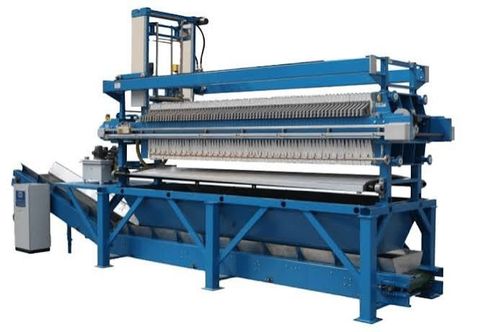
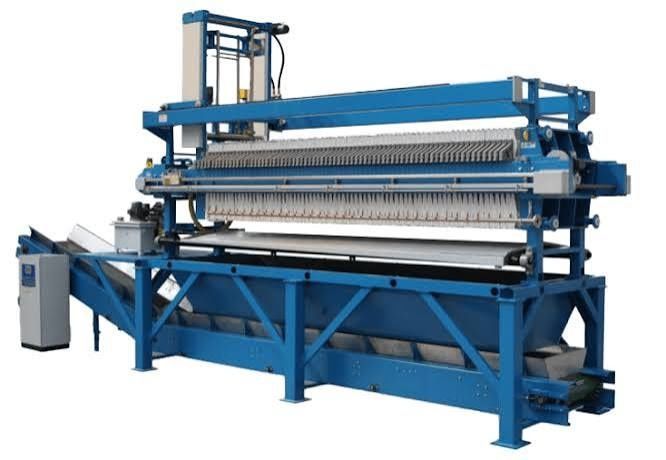
An industrial filter press typically consists of multiple filter plates covered with filter cloths. The plates are compressed together to create sealed filtration chambers.
The basic filtration cycle includes:
- Closing – Hydraulic or mechanical equipment pushes the filter plates together.
- Feeding – Slurry is pumped into the filtration chambers.
- Filtration – Liquid passes through the filter cloth while solids accumulate inside the chambers.
- Cake formation – Continued feeding builds a layer of solids called filter cake.
- Filtration completion – The cycle ends when the chambers reach their specified filling or pressure conditions.
- Opening – The plates separate after the feed stage.
- Cake discharge – The accumulated solid cake is removed from the plates.
- Cloth cleaning – Filter media can be cleaned before the next cycle.
The exact sequence can vary according to the filter press design and automation level.
Key Features of Industrial Filter Presses
Filter Plates
Filter plates form the chambers where solids accumulate. They can be manufactured from materials such as polypropylene or other materials selected for chemical and temperature compatibility.
Plate dimensions, chamber depth, and plate configuration influence the filtration area and cake volume.
Filter Cloths
Filter cloths act as the primary filtration medium. Their pore characteristics, material, weave, and surface properties influence particle retention and liquid flow.
The cloth should be compatible with the slurry and cleaning process.
Hydraulic Closing System
A hydraulic system applies the force required to close and seal the plate pack. Adequate closing pressure helps prevent slurry leakage during filtration.
Hydraulic systems can also support automated plate movement in some equipment configurations.
Feed Pump
The feed pump moves slurry into the filter press. Pump characteristics influence filling time, pressure development, and the overall filtration cycle.
The pump should be selected according to slurry concentration, viscosity, particle characteristics, and required operating pressure.
Cake Discharge System
After filtration, the plates are separated and the accumulated cake is discharged. Manual systems require operator intervention, while automated configurations can incorporate mechanical plate shifting and other discharge mechanisms.
Filtrate Collection
Liquid passing through the filter cloth is collected through internal channels and directed toward a discharge point. The filtrate can then be reused, treated further, or directed into another process.
Main Types of Industrial Filter Presses
Plate-and-Frame Filter Presses
Plate-and-frame designs use alternating plates and frames to create filtration chambers. They are suitable for various batch filtration applications.
Chamber Filter Presses
Chamber filter presses use recessed plates that create enclosed chambers for cake formation. They are widely used for sludge dewatering and industrial solid-liquid separation.
Membrane Filter Presses
Membrane filter presses include flexible membranes that can be inflated after the initial filtration stage. Additional pressure can compress the filter cake and reduce residual moisture.
Automatic Filter Presses
Automatic systems can incorporate automated plate shifting, cloth washing, cake discharge, and cycle controls. Automation can reduce manual intervention in repetitive filtration operations.
Important Components
| Component | Main Function |
|---|---|
| Filter plates | Form filtration chambers |
| Filter cloths | Retain suspended solids |
| Hydraulic cylinder | Closes the plate pack |
| Feed pump | Moves slurry into the press |
| Manifold | Directs slurry and filtrate |
| Filtrate channels | Collect separated liquid |
| Plate-shifting system | Moves plates during discharge |
| Cake outlet | Allows solids to leave the press |
| Control panel | Monitors and controls operation |
| Support frame | Holds the filter assembly |
The specific arrangement varies according to filter press type and process requirements.
Factors Affecting Filtration Performance
Slurry Characteristics
Particle size, solids concentration, viscosity, and chemical composition affect filtration behavior. Slurries with fine particles may require different filter media from coarse-particle mixtures.
Filtration Pressure
Pressure influences the rate at which liquid passes through the filter cake. Excessive pressure may not always improve filtration because cake permeability can decrease as particles become more compacted.
Filter Cloth Selection
Cloth material and pore structure influence particle retention and filtrate clarity. Incorrect cloth selection can result in poor separation or rapid clogging.
Cake Thickness
Thicker cakes can increase solids capacity per cycle but may also increase filtration time. The appropriate cake thickness depends on the slurry and desired operating cycle.
Feed Temperature
Temperature can influence viscosity and therefore filtration behavior. Higher or lower process temperatures may require specific equipment and filter-media materials.
Cycle Time
The total cycle includes filling, filtration, plate opening, cake discharge, and cleaning. Optimizing each stage can affect overall throughput.
Industrial Filter Presses vs Other Filtration Systems
| Feature | Filter Press | Vacuum Filter | Centrifuge |
|---|---|---|---|
| Main principle | Pressure filtration | Vacuum-driven filtration | Centrifugal force |
| Operation | Usually batch | Often continuous | Usually continuous |
| Cake formation | Strong | Variable | Variable |
| Solid-liquid separation | High-solids slurries | Suitable for certain slurries | Broad range |
| Cake discharge | Plate opening | Continuous or intermittent | Continuous |
| Typical use | Sludge and slurry dewatering | Process filtration | Sludge and fine-particle separation |
The appropriate technology depends on feed characteristics, desired solids concentration, operating cycle, available space, and process requirements.
Applications of Industrial Filter Presses
Industrial filter presses are used in many sectors, including:
- Wastewater treatment
- Mining and mineral processing
- Chemical manufacturing
- Food and beverage processing
- Pharmaceutical production
- Ceramic processing
- Metal finishing
- Aggregate processing
- Pulp and paper operations
- Industrial sludge dewatering
In wastewater treatment, filter presses can remove water from sludge and produce a more manageable solid cake.
Best Practices for Operation and Maintenance
Regular inspection and proper operating procedures help maintain filtration performance.
- Select filter cloths according to slurry characteristics.
- Maintain appropriate feed pressure.
- Inspect plates and cloths for damage.
- Keep filtration surfaces clean.
- Check hydraulic components regularly.
- Inspect feed pumps and valves.
- Monitor filtrate quality and flow.
- Remove filter cake at appropriate intervals.
- Clean filter cloths according to process requirements.
- Follow the equipment manufacturer's maintenance schedule.
Early identification of damaged plates, worn seals, blocked cloths, or hydraulic problems can help prevent process interruptions.
Automation and Monitoring
Modern filter press systems can incorporate sensors, programmable controls, automatic plate shifting, cloth washing, and automated cake discharge.
Monitoring systems may track:
- Feed pressure
- Hydraulic pressure
- Filtration time
- Pump status
- Plate position
- Filtrate flow
- Cycle count
- Equipment alarms
Automation can coordinate filtration with upstream slurry preparation and downstream cake handling.
Who Uses Industrial Filter Presses?
Industrial filter presses are relevant to facilities that process slurries or wastewater containing suspended solids, including:
- Water and wastewater treatment plants
- Mining facilities
- Chemical plants
- Food-processing facilities
- Pharmaceutical facilities
- Ceramic manufacturers
- Metal-processing operations
- Mineral-processing plants
Equipment selection should consider slurry composition, solids concentration, filtration area, required cake moisture, operating pressure, and automation requirements.
FAQs About Industrial Filter Presses
What are industrial filter presses used for?
Industrial filter presses are used to separate solids from liquids in slurries and wastewater. Common applications include sludge dewatering, mineral processing, chemical filtration, food processing, and industrial wastewater treatment.
How does an industrial filter press work?
A filter press pumps slurry into chambers formed by filter plates and cloths. Pressure pushes liquid through the filter media while solids accumulate to form a filter cake.
What is the difference between a chamber and plate-and-frame filter press?
A chamber filter press uses recessed plates that create enclosed filtration chambers. A plate-and-frame design uses separate frames between plates to form the spaces where filter cake accumulates.
What factors affect filter press performance?
Slurry concentration, particle size, viscosity, filter cloth characteristics, filtration pressure, cake thickness, temperature, and cycle time can all affect filtration performance.
How often should an industrial filter press be maintained?
Maintenance frequency depends on operating hours, slurry characteristics, equipment design, and manufacturer recommendations. Filter cloths, plates, hydraulic systems, pumps, seals, valves, and control components should be inspected regularly.
Conclusion
Industrial filter presses provide a pressure-based method for separating solids and liquids across wastewater, mining, chemical, food, pharmaceutical, and other industrial processes. Filter plates, cloths, hydraulic systems, feed pumps, filtrate channels, and cake-discharge mechanisms work together to complete the filtration cycle.
Performance depends on slurry characteristics, filter-media selection, pressure, cake thickness, temperature, and cycle management. Proper equipment configuration, regular inspection, and appropriate cleaning can help maintain consistent solid-liquid separation.