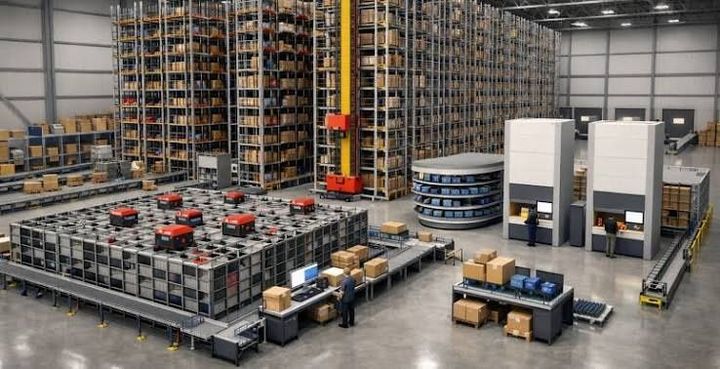
Warehouse Automation System Guide to Modern Storage and Retrieval Methods
A warehouse automation system uses machines, software, sensors, and digital controls to manage activities such as receiving, storing, moving, sorting, and retrieving goods.
Traditional warehouses depend heavily on manual movement and record keeping, while modern facilities increasingly combine automated equipment with warehouse management software. The goal is to coordinate repetitive activities through defined processes and connected technologies.
Warehouse automation systems developed from mechanical material-handling equipment such as conveyors, lifts, and sorting machines. As computers, sensors, robotics, and warehouse software became more capable, these technologies could be connected to inventory records and operational instructions. This created automated warehouse systems that can coordinate physical movement with digital information.
How Warehouse Automation Works
A typical warehouse automation system connects several components. Warehouse management software can maintain information about inventory locations and orders, while warehouse control systems coordinate equipment according to operational instructions.
Warehouse automation equipment may include conveyors, automated guided vehicles, autonomous mobile robots, robotic arms, storage machines, scanners, sorters, and lifting mechanisms. Sensors and identification technologies help systems determine where items are located and what movement should occur next.
The exact arrangement depends on the type of warehouse and the goods being handled. A facility storing small individual products may use different equipment from one handling pallets, large containers, temperature-sensitive products, or heavy materials.
Main Storage and Retrieval Technologies
Automated storage and retrieval systems are designed to place goods into designated storage locations and retrieve them when required. These systems can use cranes, shuttles, lifts, or other mechanical arrangements depending on the warehouse layout.
Other technologies include warehouse conveyor automation for continuous movement between locations and warehouse sortation systems for directing packages or containers toward designated destinations. Automated material handling systems can combine several technologies into a coordinated material flow.
Importance
Warehouse automation has become increasingly relevant as warehouses handle larger product ranges, shorter processing cycles, and more complex inventory movements. Retail distribution, manufacturing, food distribution, pharmaceuticals, and other industries can use automated systems for different parts of their warehouse operations.
For everyday consumers, warehouse processes can influence how products move from manufacturers and distribution centers toward stores or delivery networks. For businesses, automation can affect inventory visibility, material movement, order processing, and the use of available warehouse space.
Managing Repetitive Warehouse Activities
Many warehouse activities involve predictable movements. Workers or machines may repeatedly transport containers, scan products, retrieve stored goods, or move completed orders toward dispatch areas.
Warehouse management automation can coordinate these activities through digital instructions. Depending on the system design, inventory information can be updated as products enter storage, move between locations, or leave the facility.
Improving Inventory Visibility
Warehouse inventory automation connects physical inventory activity with digital records. Identification technologies such as barcodes, radio-frequency identification, cameras, and sensors can help track products or storage locations.
Accurate records depend on appropriate system configuration and reliable data. Automation can reduce some forms of manual data entry, but incorrect product information, damaged labels, sensor problems, or communication failures can still affect inventory records.
Coordinating Material Movement
Automated material handling systems can move goods between receiving, storage, picking, sorting, packing, and dispatch areas. Conveyors may provide fixed movement paths, while mobile robots can travel between different warehouse locations.
Robotic warehouse automation can also support repetitive handling activities. The role of people remains important for tasks requiring judgment, exception handling, equipment oversight, maintenance, and process management.
Key Technologies at a Glance
| Technology | Main Function | Typical Warehouse Role |
|---|---|---|
| Conveyors | Move goods along fixed routes | Transport between work areas |
| Mobile robots | Move goods between locations | Internal material movement |
| Storage and retrieval machines | Store and retrieve goods | High-density storage |
| Sortation systems | Direct goods to destinations | Order and package routing |
| Barcode scanners | Identify products | Inventory tracking |
| RFID systems | Identify tagged items | Automated identification |
| Warehouse control systems | Coordinate equipment | Equipment management |
| Robotic arms | Handle selected items | Picking, packing, or movement |
Recent Updates
From 2024 through 2026, warehouse automation has increasingly focused on flexible robotics, connected software, data analysis, and systems that can work alongside human employees. Instead of relying only on large fixed machines, some facilities are combining mobile robots, automated storage technologies, sensors, and software within the same operating environment.
Growth of Warehouse Robotics Systems
Warehouse robotics systems have expanded into activities such as transporting containers, moving shelves, sorting packages, and assisting with item handling. Warehouse robotics and automation can be configured around particular warehouse layouts and workflow requirements.
Mobile robotic platforms are also being integrated with warehouse management systems. This allows digital instructions to be translated into physical movements, although the level of integration varies between systems.
Intelligent Warehouse Automation
Intelligent warehouse automation increasingly uses data to coordinate inventory and equipment. Software can analyze information about orders, locations, equipment status, and workflow conditions to determine how activities should be organized.
AI technologies are also being explored for visual identification, demand analysis, route planning, and handling irregular objects. These applications depend on data quality and appropriate system testing, and automated decisions may still require human oversight.
Greater System Integration
Advanced warehouse automation systems are increasingly designed to connect equipment from multiple operational areas. Integrated warehouse automation solutions may link warehouse management platforms, warehouse control systems, conveyors, robots, storage equipment, scanners, and sortation technologies.
This integration can create a more connected operating environment, but it also introduces technical considerations. Communication standards, software compatibility, cybersecurity, equipment maintenance, and data consistency become important when multiple systems interact.
Flexible Automation Approaches
Complete warehouse automation systems are not necessarily identical across facilities. Some warehouses automate only storage and retrieval, while others automate transportation, sorting, picking, and inventory tracking.
This flexible approach allows automation to be applied to particular processes rather than treating every warehouse activity as identical. The appropriate arrangement depends on building design, product characteristics, order patterns, available space, and operational requirements.
Tools and Resources
Several resources can help readers understand warehouse automation concepts and evaluate how different technologies function.
Planning and Process Mapping Tools
Warehouse layout templates and process-mapping tools can illustrate how goods move through receiving, storage, picking, packing, and dispatch areas. Flowcharts can also show where automated equipment interacts with people and software.
Useful planning resources include:
- Warehouse layout templates for mapping storage and movement areas.
- Process flow diagrams for documenting material movement.
- Inventory spreadsheets for organizing product and location information.
- Equipment comparison tables for examining technology functions.
- Capacity calculators for estimating storage positions and material flow requirements.
Warehouse Software Resources
Warehouse management platforms typically maintain inventory records, order information, storage locations, and operational instructions. Warehouse control systems can coordinate equipment and communicate with higher-level warehouse software.
Documentation from equipment manufacturers, software providers, standards organizations, and technical education platforms can provide further explanations of automated storage and retrieval systems and other warehouse technologies.
Learning About Robotics
Educational robotics resources can help explain how mobile robots, robotic arms, sensors, cameras, and navigation technologies operate. Technical documentation can also describe communication methods, safety requirements, operating environments, and integration considerations.
Warehouse automation solutions often combine several technologies rather than relying on a single machine. Understanding each component separately can make the overall system easier to understand.
FAQs
What is a warehouse automation system?
A warehouse automation system uses equipment, software, sensors, and digital controls to perform or coordinate warehouse activities. These activities can include storage, retrieval, transportation, sorting, inventory tracking, and order handling.
How do warehouse automation systems improve inventory management?
Warehouse automation systems can connect inventory records with scanning, sensors, storage equipment, and warehouse software. This can provide digital information about product locations and movements, subject to the accuracy of the underlying data and equipment.
What are automated storage and retrieval systems?
Automated storage and retrieval systems use mechanical equipment and control software to place goods into designated storage locations and retrieve them when required. Different designs can handle containers, pallets, or other warehouse units.
What is the role of warehouse robotics systems?
Warehouse robotics systems can support activities such as transporting goods, moving storage units, sorting items, and handling selected products. Their functions depend on the robot type, warehouse layout, software integration, and physical characteristics of the goods.
What is warehouse conveyor automation?
Warehouse conveyor automation uses powered conveyor equipment and control systems to move goods along predefined routes. Conveyors can connect areas such as receiving, storage, picking, sorting, packing, and dispatch.
Conclusion
Warehouse automation combines physical equipment, software, sensors, and control technologies to coordinate storage and material movement. Automated storage and retrieval systems, conveyors, sortation equipment, robotics, and inventory technologies can each perform different roles within a warehouse. From 2024 through 2026, development has increasingly involved flexible robotics, connected software, data analysis, and integrated control systems. The structure of an automated warehouse depends on its products, layout, workflow, inventory requirements, and level of automation.